Showing posts with label Music. Show all posts

Sunday, March 9, 2014

Noviembre - A film by Achero Manas


Noviembre, a Spanish film by Achero Manas revolves around an idealistic street theatre troupe, which wrestles against its existence against several odds – social, political and financial in nature. The story has been presented in the form of a retrospective; a fictitious documentary where some elderly members of the group share the memories of their youth.

Together, these members tell the story of their friend Alfredo, whom they met at a drama school in Madrid. A young, bright and talented boy, his thoughts were wavering, creative, idealistic and liberal. He was disappointed with the pedantic ways of the drama school which hindered free flow of ideas. He believed drama to be a form of art that needed participation of both the performers and the spectators; and interaction between them. His concept of theatre extended beyond the stage and came face to face with the people – It came straight from the actors’ heart and connected with the people.

So, Alfredo came up with his own theatre group “Noviembre”. He and his friends performed outdoors, in the town square, in streets, parks, provoking people with their acts of demons, lunatics and so on. They swept their viewers away with laughter, tears, fear and surprise.


The story, on one hand, depicts the struggle of Noviembre with a shoestring budget; and legal problems, bans, police arrests kept them busy.  On the other hand, it shows their internal ideological conflicts and problems in their personal lives. Complications arise when money comes into play, widening the chasms in the group.

The film ends with a perfect climax where Alfredo, cornered in personal as well as professional life, sacrifices himself for Art, for Art always triumphs! He is shot dead by the police in his last show.
A dynamic story, combined with smart story-telling, Noviembre is a treat for the eyes. The film lets us relive the true essence of street dramas and aptly reveals the revolutionary potential of theatre, how it can arouse one’s conscience, and spark a change in the era when rapid commercialisation of Art had eaten away its true spirit.


The actors had been well cast, and Oscar Jaenada was flawless in the shoes of Alfredo. With the message, the film packed moments of laughter, drama, sorrow, romance and didn’t fail to leave a little for the imagination of the audience.

Saturday, February 22, 2014

IPTA : A stage for social commitment


The Indian People’s Theatre Association (acronymed   as the IPTA) was the cultural wing of the Communist Party of India, an initiative by theatre-artists with a dream of bringing about a cultural reawakening among the Indian people.  Anil De’ Silva assisted in the formation of IPTA in Bombay in 1943. It came about as a result of a multifarious backdrop: the devastating man-made Bengal famine of 1943, the repression of the British colonialists, and the attacks on the Soviet Union by various fascist powers were many of the issues its founders felt strongly about. 

Some of the initial members of the groups were Prithviraj Kapoor, Bijon Bhattacharya, Ritwik Ghatak, Utpal Dutt, Khwaja Ahmad Abbas, Salil Chowdhury, Pandit Ravi Shankar, Jyotirindra Moitra and many other stalwarts. IPTA committees were formed throughout the nation, permeating the worlds of theatre, cinema and music.

 The mission statement of IPTA is ‘People’s Theatre Stars the People’. The logo designed by the famous painter Chitta Prasad is a drummer (nagara vadak), a reminder of one of the oldest mediums of communication. The name “People’s Association” was suggested by Homi Jahangir Bhabha who was inspired by Romain Rolland’s book on People’s Theatre.

The IPTA staged many noteworthy dramas throughout the country: the most renowned of these being Nabanna (Harvest), portraying the plight and the starvation deaths of millions. Similar productions were carried out all over the country.

Modern choir singing in India was also initiated by IPTA. Pt. Ravi Shankar composed Iqbal’s ‘Sare Jahan Se Achha’ for the Central Cultural Troupe of IPTA established in 1944. Many others penned and composed songs in different languages. These artists created what we call Janasangeet (people’s music) once again underlining the philosophy of the group.                                                                                                                
Around 1960, IPTA disintegrated at the national level. However its main members continued to carry the legacy of IPTA by forming several groups with similar ideology. IPTA Bombay was an offshoot that continues to produce dramas till date. Group theatres like Bahurupee (led by Shambhu Mitra), People’s Little Theatre (led by Utpal Dutt) and Nandikar (led by Ajitesh Bandopadhyay and others) of Kolkata continued to produce socially and politically conscious dramas; and recently there have been efforts to start a similar movement inspired by the IPTA.

In his Presidential Address in 1943, Hiren Mukherjee had said: “Come writer and the artist, come actor and the play-wright, come all who work by hand or by brain, dedicate yourselves to the task of building a brave new world of freedom and social justice.” Perhaps these powerful words best sum up the mission of this radical group.

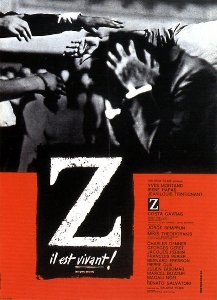
Review: 'Z', a film by Costa Gravas


"Why do our ideas provoke such violence? Why don't they attack other organisations?",asks Grigoris Lambrakis, the Greek politician, to a bustling crowd of his supporters, "our ideas" signifying leftism and pacifism. "The answer is simple. The others are nationalists, used by the government, and don't upset our Judas allies who betray us..."

"Z", the critically acclaimed political thriller by the French director  Costa-Gavras, is based on a real event, that of the assassination of the above mentioned Lambrakis and how the government tried its level best to disguise it as an accident and hush it up. At a time when military-dominated government was at its peak in Greece,the opposition party's Lambrakis and his associates plan to hold a rally to speak against nuclear disarmament. All of a sudden, they find that all the halls in the city have closed their doors to them, obviously having been threatened by some higher power. Finally, at the behest of the Head of Security, they are allowed to use a small hall right across the street from Lambrakis' hotel. After the rally, as he's making his way back to the hotel, a pick-up truck  appears out of nowhere and hits him.

 As he's rushed to the hospital, the police find the driver of the pick up truck and question him.  Even though Lambrakis' associates can smell something fishy, the Chief of Police insists that  the case be closed as an accident due to drunken driving. His reason? To prevent any harm and disruption to the existing law and order! Lambrakis dies soon after and the autopsy reveals a shocking fact. The injury of the skull is such that it could only have been caused if he was deliberately hit with a club-like object! Ensuing investigation by the magistrate Sartzetakis reveals enough evidence to show that the assassination of the leader of the opposition was masterminded by none other than the top miltary officials of the right-wing government, including the Chief of Police who was so keen on hushing it up! The officers are indicted for the time being, but very soon the real outcome turns out to be quite different...

The seven witnesses die mysterious deaths just before the trial. The assassinators are given ridiculously short sentences, and the military officers receive only administrative reprimands. All of Lambrakis' associates either die or are deported. The military regime soon banned anything it saw as radical and as a threat to their authority, including the letter 'Z', which signifies, 'He (Lambrakis) is alive'...


This movie was based on events which happened in the 1960s. But even now, can we really say that the situation has vastly changed for the better? Extremism still thrives in many parts of the world. As for this tendency of the higher authority to hush everything up which might disrupt order, well, don't we face such incidents almost regularly in our daily life? It's as if the new definition of democracy seems to imply that it is alright to deny justice, if order is maintained, and the reputation of the institution remains intact...

Tuesday, February 11, 2014

The Unarmed Rebel


The legendary banjo-playing folk singer is no more with us. Pete Seeger died at a hospital in New York on 27th January, 2014. The legendary folk-singer who was the voice behind all the songs ‘We Shall Overcome’ and ‘Where Have All The Flowers Gone?’  was also known for his lifelong fight for civil rights, racial equality and his campaigns for peace, disarmament and cleaner environment. Seeger used folksong as the medium through which he could express his views.

Born in a family where his parents were trained in classical music, Pete Seeger carved out his own niche in folk music and chose folk music as his medium to express and protest. He popularized the 5-string banjo which he heard for the first time at the Mountain Dance and Folk Festival in North Carolina. He attended the festival, organized by a local folklorist Liensford while travelling with his father and stepmother. In 1948, Seeger wrote the first version of his classic ‘How To Play The Five-String Banjo’. He later invented the Long-Neck or Seeger Banjo , an instrument that is nearly three-feet longer than a typical banjo and slightly longer than a bass guitar. From the late-1950s, Seeger also began to use the 12-string guitar, an instrument of Mexican origin.

Seeger was influenced by the Marxist ideologies and was a member of the Communist Party even though he later drifted away from the Party. During the infamous McCarthy days, Seeger had to face a lot of humiliation for his Leftist leanings and for being a member of the American Communist Party. He was even sentenced to a one-year jail term in 1962. A multi-faceted personality, Seeger was associated for movements of peace, disarmament and civil rights. His anti-War songs like ‘Where Have All The Flowers Gone?’, ’Turn! Turn! Turn!’ gained wide popularity. His famous song ‘We Shall Overcome’ became the anthem of Civil Rights Movement. He inspired generations of musical icons like Bob Dylan and Bruce Springsteen.

A lifelong opponent of the arms race and war, Seeger vehemently opposed the Vietnam War satirically attacking the U.S Government through his songs. In one of his immortal songs, a soldier coming from a lower-middle class background during the Vietnam War asked his superior “Tell me how to kill, Sergeant, as I have never killed before.” The soldier had learnt from his parentrs not to hurt anyone, let alone kill!

Seeger was also an ardent environmental activist and was associated with the environmental organization Hudson River Sloop Clearwater, cofounded by him in 1966 to fight against the pollution of Hudson River.

The legendary folksinger came to India twice. In 1966 he had sold out concerts in Kolkata and Delhi. In Delhi he had sung the famous Cuban song of freedom ‘Guantanamera’ on the request of the audience. In Kolkata, to everybody’s surprise, he sang ‘Raghupati Raghav Raja Ram’ and even some nursery rhymes.

With the death of Pete Seeger, the world has lost a great fighter; a hero, who, through his songs, gave us a sense of direction, showed us where we came from and where to go to.